

When I initiated coverage on Carasent in August 2025, the thesis was simple. It was a sticky, high-margin healthcare software engine, buried under the 2020–2022 acquisition spree and run by an operator who would let the operating leverage show. Q3-25 was the inflection point. In Q4-25 I bought the AI panic. Q1-26 was core strength under surface noise, and Q2-26 was another tick in the box.
Q3-26, reported this morning, is more of the same, with one addition. The ARR engine keeps running across multiple growth vectors, EBITDAC is improving further, and now the cash is showing up on top of it.
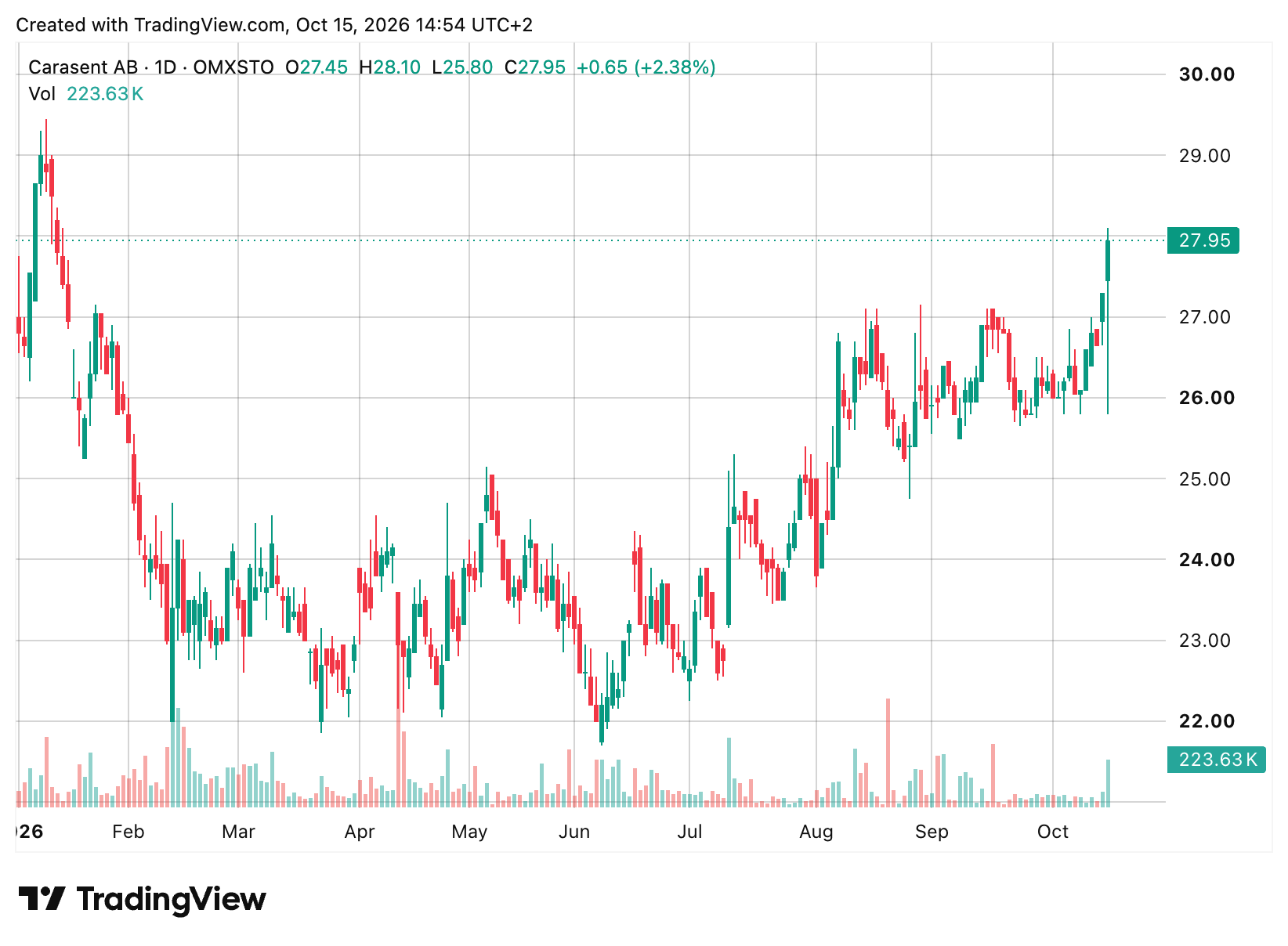
The stock is up about 5% to SEK 28 on the day, back towards the top of the range it has traded in since the spring.
Further down I also take a detour via Tandem Health, the Stockholm AI-scribe scale-up valued at SEK 2.4bn and counting. It does roughly what Medsum does, at twice the price and without owning the patient record. I read it less as a threat and more as a public price tag on the AI functionality Carasent already has inside Webdoc, and which the market gives it no credit for.
Snapshot: Carasent AB (publ)
Ticker: CARA.ST (Nasdaq Stockholm)
Share price: ~SEK 28 (15 October 2026, intraday)
Market cap: ~SEK 1.87 billion (66.9m shares outstanding)
Enterprise value: ~SEK 1.8 billion
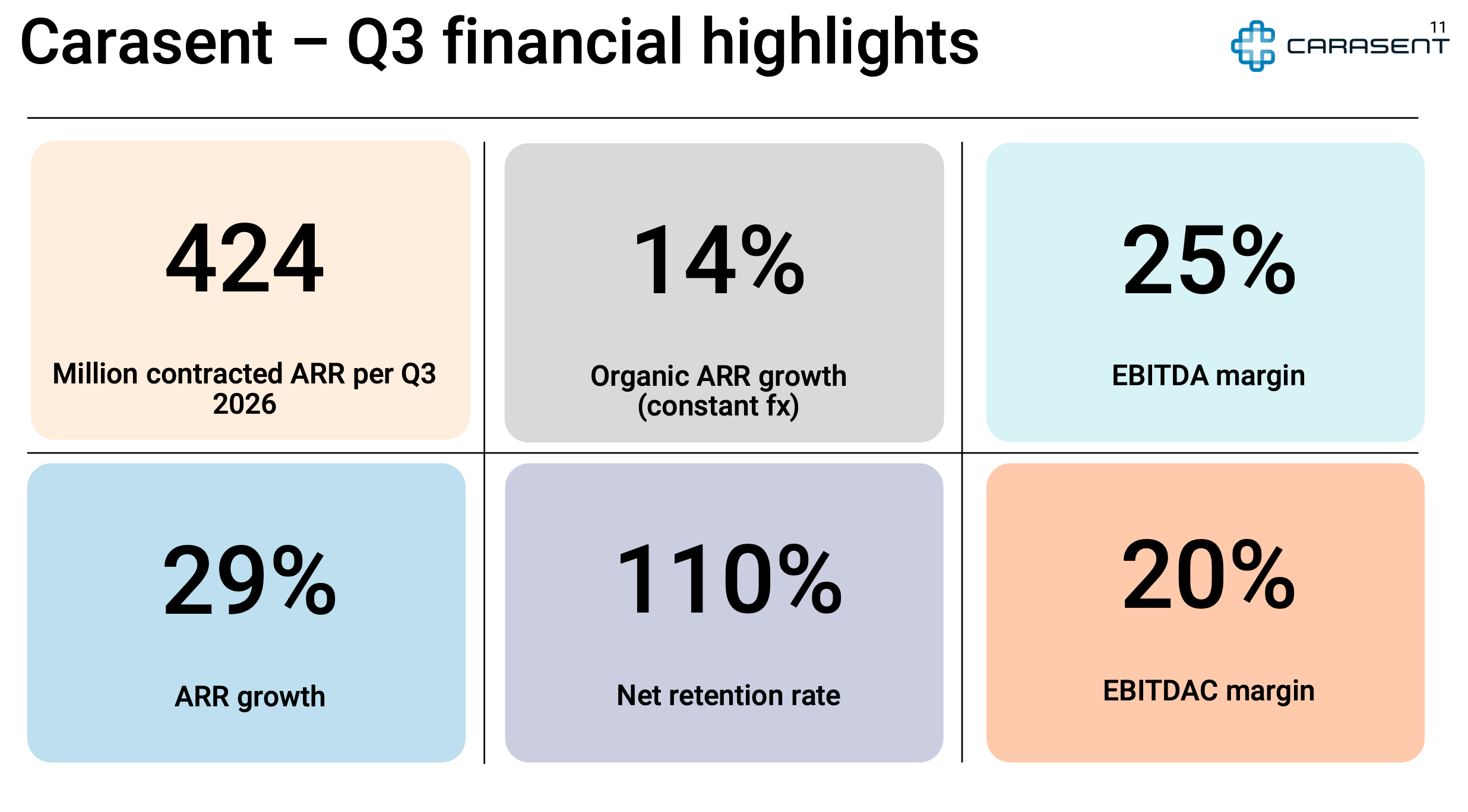
ARR: SEK 416m (+29% reported, +14% organic)
Verdict: High-conviction BUY, unchanged (more below)
Revenue update: 14% organic ARR growth, Nordics doing the work
Net sales of SEK 108.2m were up 32%, of which about 20 points came from InfoSolutions, consolidated for its first full quarter. If we take out M&A and currency, organic growth was 12%. Underneath, organic ARR growth was 14%.
14% is a touch below the 15% in Q2 and the 16% a year ago. But the reason matters. Daniel Öhman says it plainly in the CEO letter: the Nordics are growing well and Germany is diluting. German revenue fell from SEK 9.5m to 8.5m as the legacy Data-AL products wind down, and that drag is sitting inside the group number. The core is fine.
The sales pipeline agrees. Falck Norge has chosen Metodika, worth SEK 2–3m in ARR from January 2027. Frelsesarmeen extended its Ad Curis contract by another SEK 1m. Signed-but-not-yet-live ARR is now SEK 8m. Net revenue retention is 110%, which means the installed base grows by a tenth each year before anyone signs a new logo. Churn stays at 3%.
Margin update: EBITDA down and EBITDAC up
The number pessimists will quote is the EBITDA margin. It was 25%, down from 29%. The explanation is in the report and it is the opposite of a problem.
Carasent capitalised SEK 6.0m of development in Q3, down from SEK 11.3m a year ago. Capitalising development lifts EBITDA, because developer salaries go to the balance sheet instead of the P&L. Capitalising less does the reverse. So the EBITDA margin fell for an accounting reason, not a business one. Nothing to do with InfoSolutions either, as management says the acquired business is already running at group margin, before its price increases take effect in January.
That is why I keep banging on about EBITDAC, which takes capitalised development back out. It is the closest thing to cash operating profit in a quarterly report, and it does not care how much R&D you choose to put on the balance sheet.
On that measure Q3 was excellent. EBITDAC rose to SEK 21.4m from SEK 12.2m, a margin of 20% versus 15%. Over nine months the adjusted EBITDAC margin went from 8% to 14%.
Profit after tax fell from SEK 14.1m to 10.3m, but Q3-25 included a SEK 6m tax credit. Pre-tax profit actually rose 17%.
Cash flow update: SEK 73.7m in nine months
If I had to frame one number from this report it would be nine-month operating cash flow of SEK 73.7m, up from SEK 19.8m. It was driven by three thing, namely higher operating profit, receivables unwinding after last year’s invoicing clean-up, and less development being capitalised. Free cash flow before acquisitions was SEK 48m, against minus SEK 11m a year earlier.
Where did the cash go? SEK 92m net on InfoSolutions, SEK 40m on buying back 1.6m shares, and 2m shares were cancelled in May. Cash is down to SEK 47m from SEK 139m at year-end, with no bank debt at group level. The balance sheet is lighter than it was, and deliberately so.
Deep dives
InfoSolutions: already earning its keep
Carasent paid SEK 127m (SEK 115m cash plus SEK 12m in treasury shares) for a business with SEK 67m of 2025 revenue, SEK 41m of it recurring, and roughly zero EBITDAC. Three times recurring revenue for a break-even business made some investors nervous. I argued at the time that it was a moat purchase, not a margin purchase.
Four months in, it is both. After the 25% headcount cut at acquisition, InfoSolutions is already at group margin, and a 20% price increase on its ARR takes effect in January 2027. InfoSolutions handles the electronic lab orders and results between Swedish clinics and laboratories, regardless of which EHR the clinic runs. That gives Carasent two things. First, a transaction fee on lab traffic from competitors’ customers as well as its own. Second, higher switching costs, since a clinic leaving Webdoc would also need to replace its lab integration.
Medsum becoming a success story
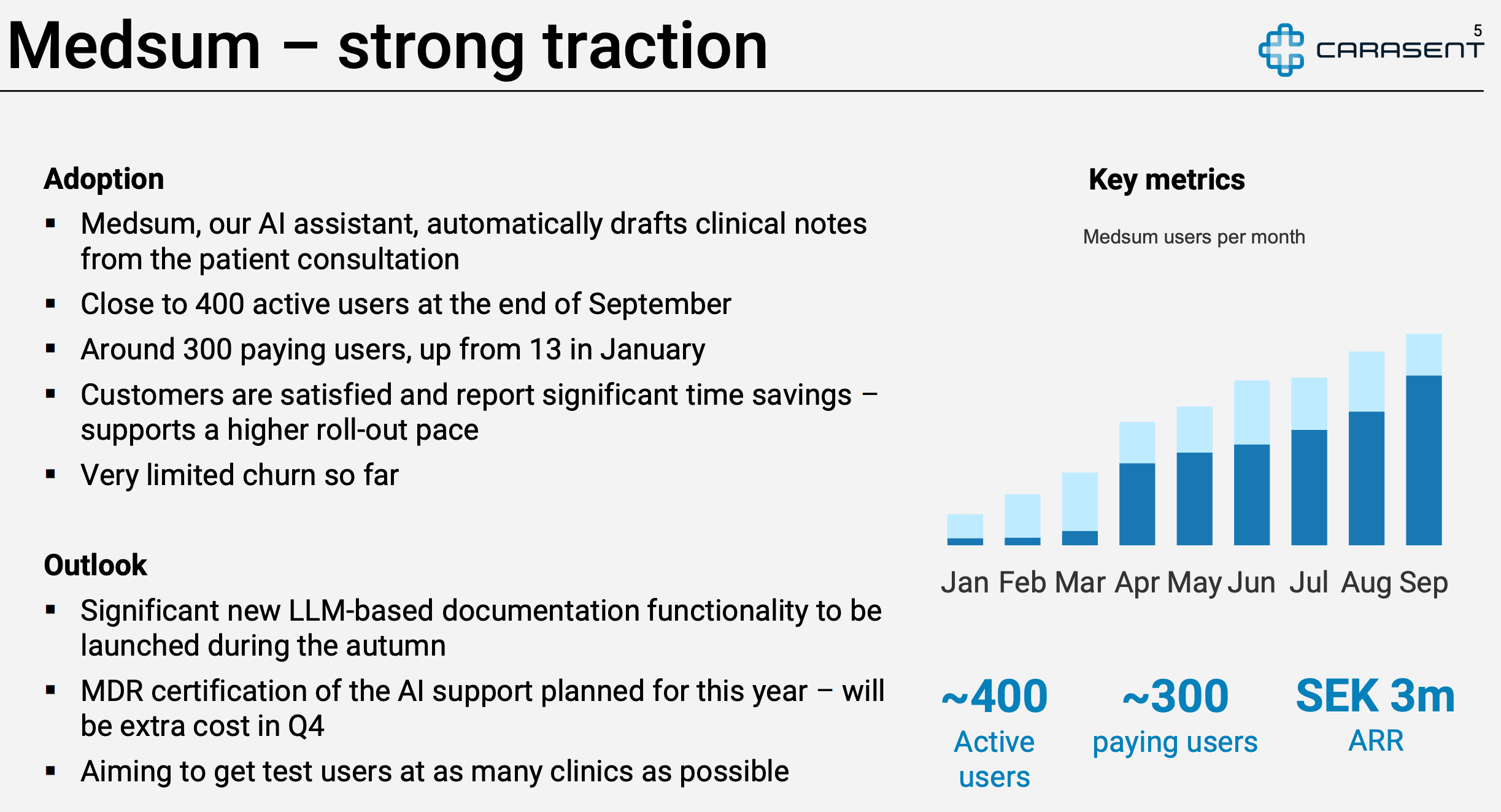
Medsum, the AI assistant that listens to the consultation and drafts the journal note inside Webdoc, is now Carasent’s best-selling add-on. Paying users went from about 200 to just over 300 during Q3, with close to 400 including trials. That is 50% growth in a quarter when half the Nordics was on holiday.
At SEK 750 per user per month, 300 users is roughly SEK 2.7m of ARR, which is still a small number in a SEK 416m ARR base. What matters is the trajectory and what comes next: around the turn of the year Carasent rolls out a new Webdoc interface with AI through the whole workflow, where agents pick up every action agreed in the room (sick leave, prescription, follow-up) and draft it in the right place in the record with full patient context. That is a different product from a note-taker. It is the clinic’s admin layer.
The Tandem comparison
Here is the part that should make Carasent shareholders sit up.
Tandem Health, founded in Stockholm in 2023, sells an AI scribe for clinicians. It listens to the consultation, drafts the note, suggests codes, and pushes the result into one of 100+ medical record systems. It is, functionally, Medsum without the EHR. It is also very good at raising money. Kinnevik led a SEK 475m round in 2025 that valued the company at SEK 2.4bn according to Di. In September 2026 it raised a further $100m Series B led by EQT’s Scaleup Europe Fund, valuation undisclosed. Nobody raises a $100m B round at a lower price than the A.
Tandem’s 2025 revenue was about SEK 43m, growing fast from almost nothing. Carasent’s was SEK 344m. Yet on the 2025 round alone Tandem was worth more than Carasent’s entire market cap is today.
Two ways to read this, and I think both are right.
The optimistic reading. The market is paying a fortune for “AI that removes doctor admin”. Carasent already owns the workflow, the patient data and the distribution. Medsum does not need a sales team, they can just switch the functionality on with existing customers.
At today’s SEK 750 and assuming 50% penetration of 18,000 clinicians, that is SEK 80m of near-pure-margin ARR. At Tandem’s price point it is SEK 160m. On the current share price, the market is giving Carasent credit for none of it. That is hidden optionality sitting inside the EMR.
The sober reading. Tandem is a serious company. SEK 43m of revenue after two years, three MDR-certified devices, 100 in-house clinicians, and close to SEK 1bn of fresh capital. But it does not sit on the EHR, and therefore not on the patient data and context. For a clinic already on Webdoc, the choice should not even be debated. Medsum is half the price, fully integrated, needs no second login, and keeps the data where it already is. The user growth says clinicians agree, and more functions arrive with the new AI workflow at year-end.
Tandem’s real effect on Carasent is to open the market with a well-funded sales force teaching Nordic and European clinicians that AI documentation is worth paying four figures a month for. Carasent then collects on that education inside its own base, at a price that looks like a bargain by comparison.
In healthcare, the system of record wins the workflow. I will keep watching the Medsum user count each quarter, but I would not over-index on the competitive risk.
Germany is slower than planned
Germany remains the soft spot. Data-AL revenue is declining, Webcur has taken longer to launch than planned, and together they weigh on group results. A new German CEO has been in place since September, new salespeople are hired, and spend goes up in Q4.
What I care about is behaviour, not speed. Carasent has not bought growth with discounts to paper over the delay. I continue to model Germany at close to zero. Any real traction is upside.
Valuation update
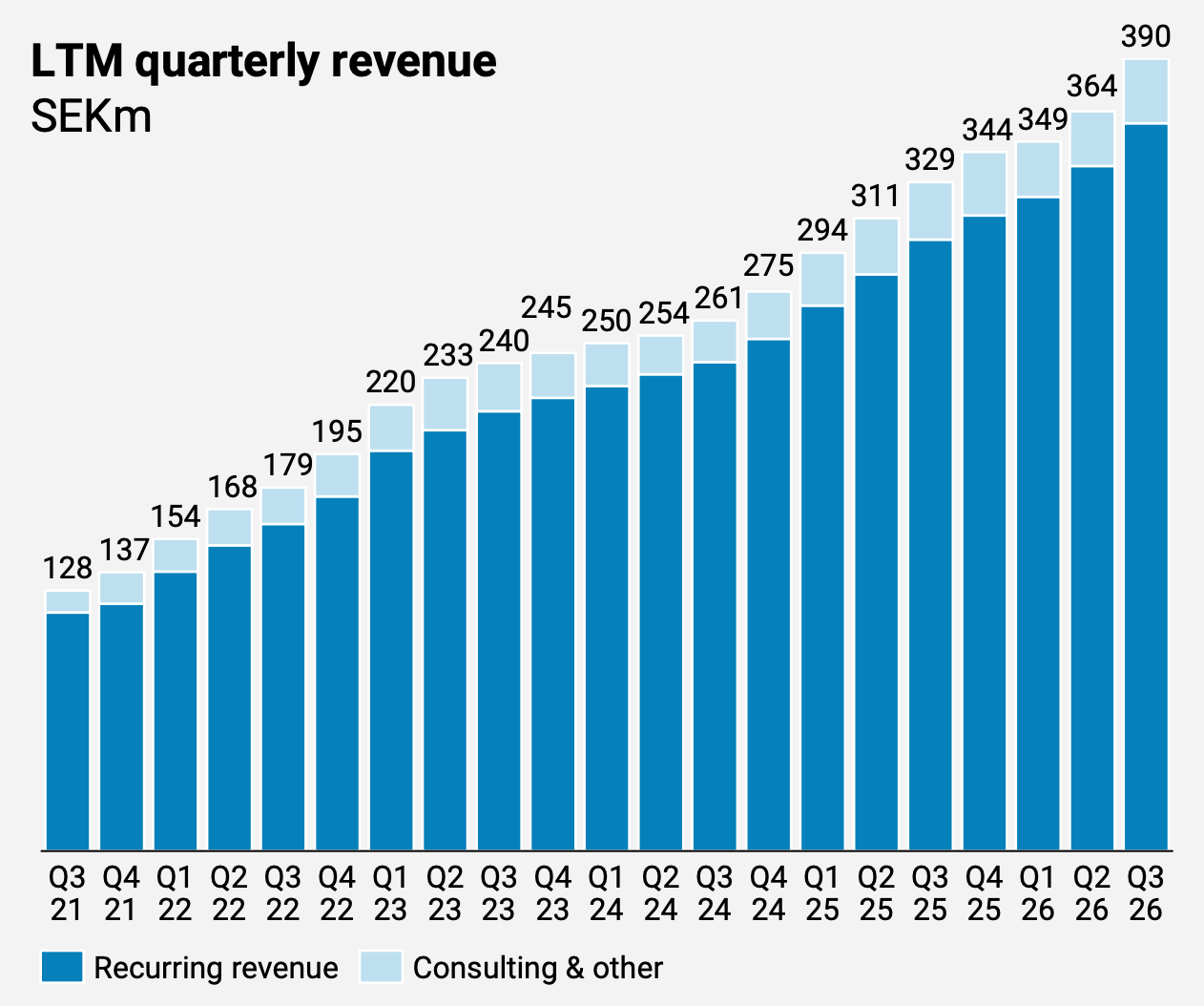
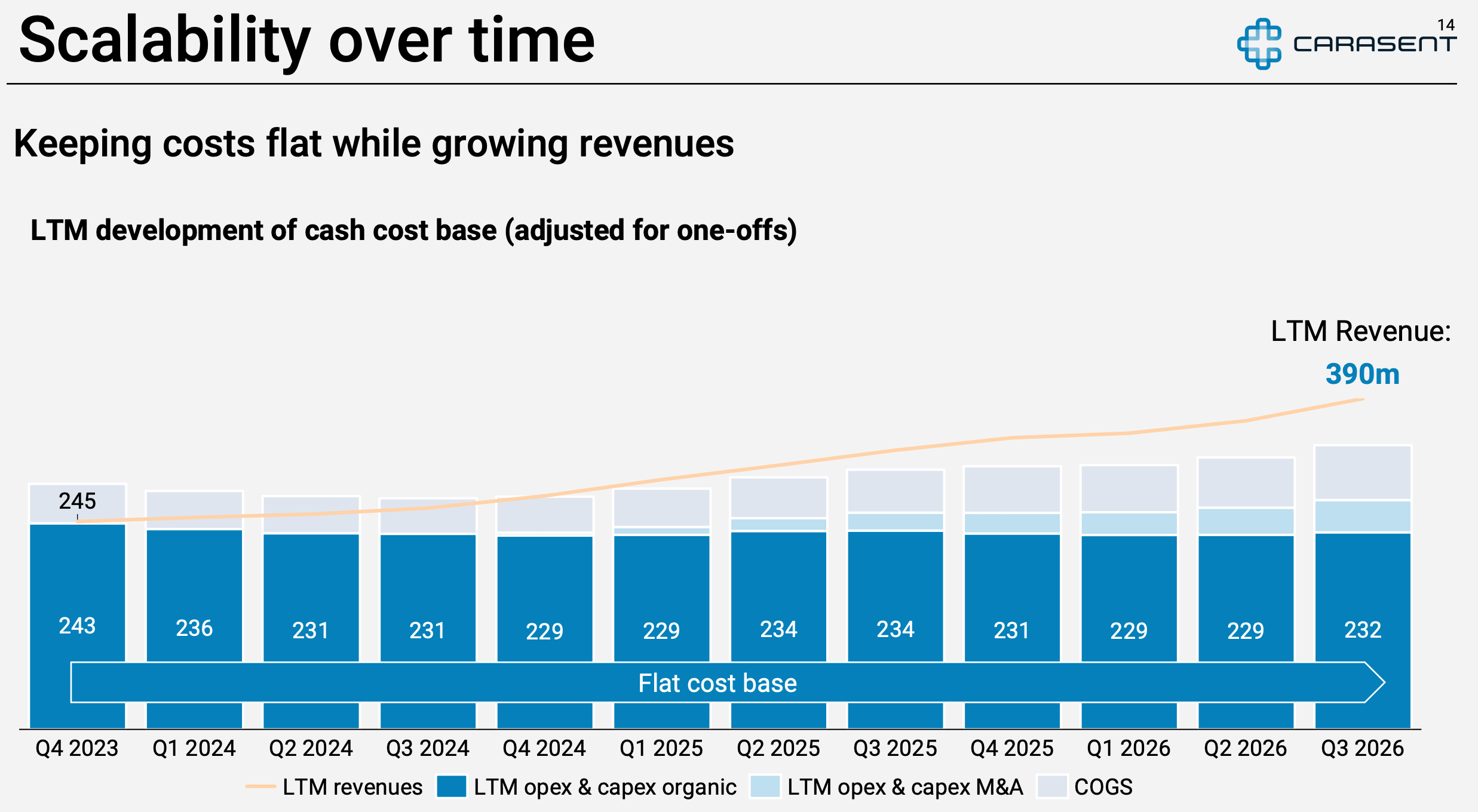
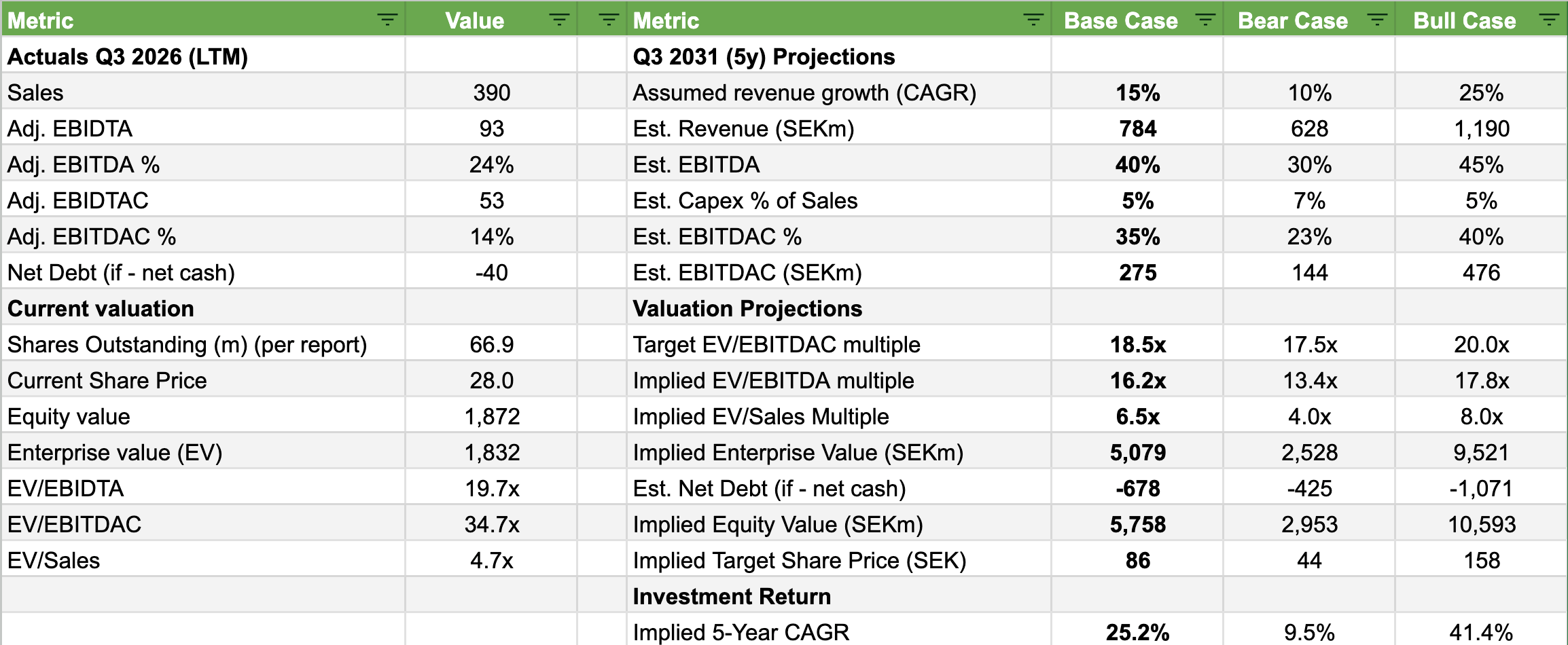
At SEK 28 the market cap is about SEK 1.87bn and the EV about SEK 1.83bn, or roughly 4.7x trailing twelve-month sales. For a business growing ARR organically at 14%, a flat fixed cost base, and 84% gross margins that is not a demanding price.
I have rolled the five-year model forward to Q3 2031, using the same logic as before. I.e., grow revenue, let the cost base lag, take out capex, apply an exit multiple on cash operating profit, and add the cash that accumulates along the way.
Three notes on the model.
First, 15% from a SEK 390m base is now conservative, since the base only includes four months of InfoSolutions. Pro forma it is closer to SEK 435m.
Second, the base-case capex of 5% sits below management’s 6–9% guidance, but that guidance covers the 2026–28 build phase. Capitalised development is already falling (SEK 6.0m in Q3 versus 11.3m a year ago, and under 6% of Q3 sales), and about half of what remains is the Webcur build for Germany, which rolls off once the platform is launched. By 2031 a mature system of record should be at maintenance levels, and 5% is my estimate of that.
Third, the exit multiple of 6.5x sales versus 4.7x today contributes 7 points of the 25%. The rest is growth, margin and cash. Note that even the bear case returns a positive 9% a year.
Final thoughts and watchpoints
Verdict unchanged: High conviction BUY.
Q3 was another quarter of steady execution. Organic ARR grew 14% with the Nordics doing the work, the EBITDAC margin reached 20%, and InfoSolutions is already at group margin with a price increase still to come. Medsum went from 200 to 300 paying users over the summer and gets a full AI workflow at year-end. Germany is behind plan and needs watching, but it is modelled at close to zero.
A new angle this quarter is Tandem Health. A standalone AI scribe, without the patient record, is valued above the whole of Carasent. For a clinic already on Webdoc, Medsum is the obvious choice - it is half the price, fully integrated, and clinicians are adopting it. Tandem’s money is opening the market for AI documentation, and Carasent collects on it inside its own base. The market gives Carasent no credit for this today. That is hidden value.
✅ Organic ARR growth 14%, NRR 110%, churn 3%
✅ EBITDAC margin 20%, up 500 bps YoY
✅ 9M operating cash flow SEK 73.7m, up 272%
✅ InfoSolutions at group margin, 20% price hike from January 2027
✅ Medsum paying users +50% in a quarter, AI workflow launch at year-end
✅ Tandem Health’s SEK 2.4bn-plus valuation: a public marker for what Medsum could be worth
⚠️ Germany: Webcur launch delayed, Data-AL declining
🎯 5-year target (base case): SEK 86
📈 Implied 5-year compound return: ~25% CAGR from SEK 28
💡 Conviction level: HIGH (BUY)